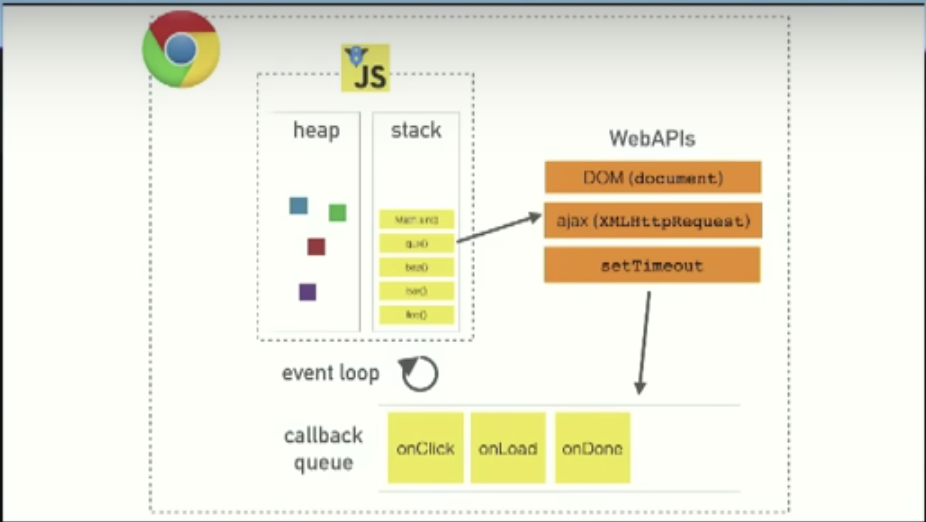
Macrotask queue (or simply Callback Queue or Task Queue in Browser)
To schedule a new macrotask: use zero delayed setTimeout(f).
The following goes to macrotask queue:
setTimeout, setInterval, setImmediate
requestAnimationFrame
I/O
UI rendering
script tag, script execution
Microtask queue (aka Jobs in Browser)
There’s no UI or network event handling between microtasks: they run immediately one after another.
One micro task can schedule another micro task. Event loop continuously runs all the micro task.
To schedule a new microtask, use queueMicrotask(f).
The following goes to microtask queue:
Promise callbacks
process.nextTick
queueMicrotask
Simplified Event loop algo
Dequeue and run the oldest task from the macrotask queue (e.g. “script” execution).
Execute all microtasks:
While the microtask queue is not empty:
Dequeue and run the oldest microtask.
Render changes if any.
If the macrotask queue is empty, wait till a macrotask appears.
Go to step 1.
Example
console.log(1);// The first line executes immediately, it outputs `1`.// Macrotask and microtask queues are empty, as of now.setTimeout(() => console.log(2));// `setTimeout` appends the callback to the macrotask queue.// - macrotask queue content:// `console.log(2)`Promise.resolve().then(() => console.log(3)).then(() => console.log(3.1));// The callback is appended to the microtask queue.// - microtask queue content:// `console.log(3)`Promise.resolve().then(() => setTimeout(() => console.log(4)));// The callback with `setTimeout(...4)` is appended to microtasks// - microtask queue content:// `console.log(3); setTimeout(...4)`Promise.resolve().then(() => console.log(5));// The callback is appended to the microtask queue// - microtask queue content:// `console.log(3); setTimeout(...4); console.log(5)`setTimeout(() => console.log(6));// `setTimeout` appends the callback to macrotasks// - macrotask queue content:// `console.log(2); console.log(6)`console.log(7);// Outputs 7 immediately.
The whole script will run first which is a macrotask: 1, 7
Then all the microtasks are executed: 3, 5 and 3.1 is scheduled as microtask since it is a settled promise