Tracing

  • Spring Cloud Sleuth
    • Enables distributed tracing
    • Simple facade for distributed tracing systems
  • Micrometer Tracing is successor of Spring Cloud Sleuth

Setting up Tracing

compileOnly 'io.micrometer:micrometer-tracing'  
implementation 'io.micrometer:micrometer-tracing-bridge-otel'
  • application.yml config
spring:
  zipkin.enabled: true
  zipkin:
    base-url: ${ZIPKIN_BASE_URL:http://localhost:9411}
    sender:
      type: web
  # not sure if sleuth config is required or not
  sleuth:
    sampler:
      probability: "1.0"
  • Launch Zipkin server:
# Navigate to http://localhost:9411/zipkin on browser
docker run -d -p 9411:9411 openzipkin/zipkin
  • Download opentelemetry-javaagent.jar
  • Launch app:
# OTEL supports:
# OTEL_LOGS_EXPORTER, OTEL_METRICS_EXPORTER, OTEL_TRACES_EXPORTER
export OTEL_METRICS_EXPORTER="otlp" # Is this required?
export OTEL_SERVICE_NAME=bff-mobile
export OTEL_TRACES_EXPORTER=zipkin
 
# Use this to check if OTEL javaagent is really working
export OTEL_JAVAAGENT_DEBUG=true
 
# Build the jar
./gradlew clean build -x test
 
java -javaagent:./service/build/docker/opentelemetry-javaagent-1.31.0.jar -jar ./service/build/libs/bff-mobile-0.536.0-SNAPSHOT-application.jar
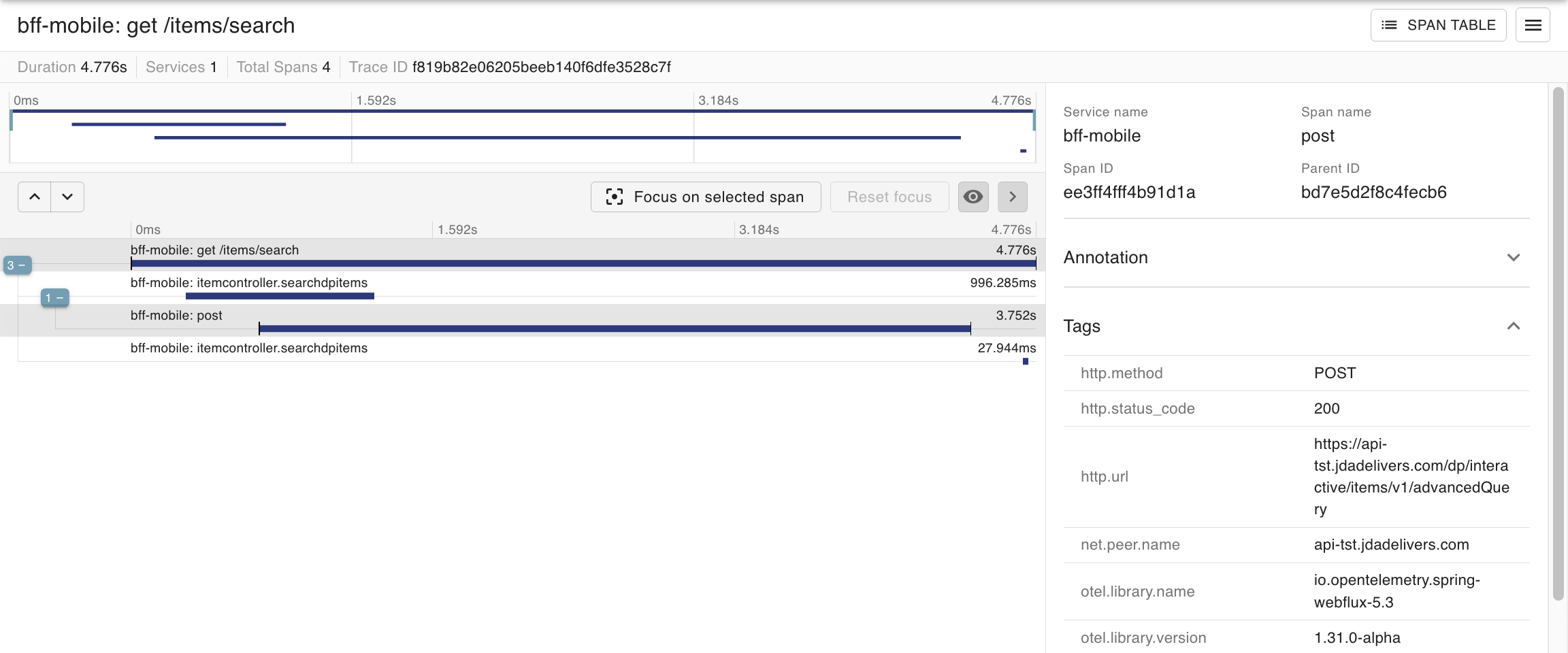
  • The following screenshot is from zipkin capturing info
  • There are multiple spans of service bff-mobile denoting:
    • method call (example: itemcontroller.searchdpItems)
    • API call (example: post) telemetry_tracing_zipkin_example

Tracing Terms (Dapper)

  • Span: Basic unit of work.
    • They contain metadata
    • Can be started and then stopped
    • For example:
      • Sending RPC
      • Sending RPC response
  • Trace: Set of spans forming tree structure
  • Tracer: a library that handles span lifecycle
  • Tracing Context: Identifier (Trace identifier/span identifier etc.) that must be propagated through the process and over network
  • Spans are collected from all the places and then unified using tracing context (traceId) which will be unique for all the requests between microservices

Trace ID

  • Trace ID needs to be propagated and consumed. so that when collected they can be unified in distributed tracing software and show information
  • you can configure it in application.properties:
management.tracing.propagation.consume=W3C, B3, B3_MULTI
management.tracing.propagation.produce=W3C
management.tracing.propagation.type
  • W3C provides TraceContext standard distributed tracing to work. Headers include:
    • traceparent
    • tracestate
  • other popular header formats:
    • Zipkin (B3-*)
    • Jaeger (uber-*)
    • OpenTracing ‘sample’ headers (ot-*)
  • OpenTelemetry has adopted W3C TraceContext and Zipkin’s B3 format

traceparent

traceparent: 00-4bf92f3577b34da6a3ce929d0e0e4736-00f067aa0ba902b7-01
  • Version (2): 00
    • version of traceparent specification
  • Trace ID (32): 4bf92f3577b34da6a3ce929d0e0e4736
    • unique identifier for the entire trace.
  • Parent ID (16): 00f067aa0ba902b7
    • identifier for the parent span
  • Trace Flags: 01
    • extra information about the trace
    • 01 means trace is sampled and should be recorded

traceparent vs correlationId