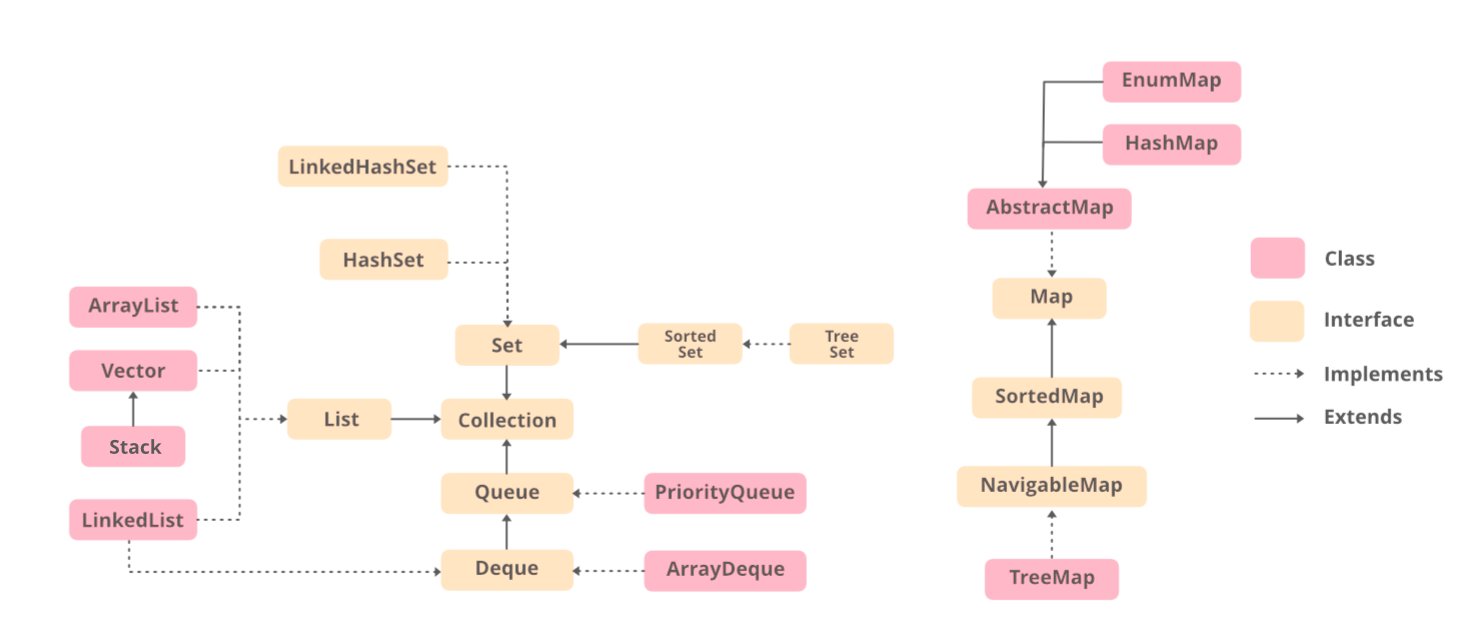
Vector synchronizes on each individual operation. Generally you want to synchronize a whole sequence of operations. Hence it is inefficient
LinkedList is a doubly linked list and is different from queue
although you will think that removal by object reference is O(1) but that is not the case with LinkedList since it does not expose Node object (which contains prev/next references) hence object is searched making its complexity O(N)
The following is true for corresponding HashSet, TreeSet and LinkedHashSet as well
HashMap: unordered keys
based on Hash table
O(1) get / put / remove / containsKey
TreeMap: sorted keys
based on Red-black tree
O(logN) get / put / remove / containsKey
LinkedHashMap: keep insertion order
based on Hash table and linked list
O(1) get / put / remove / containsKey
takes more memory compared to HashMap
HashMap
Syntax
Map<String, Integer> map = new HashMap<>(initialCapacity, loadFactor);
TreeMap
Syntax
// using map interfaceMap<String, Integer> map = new TreeMap<>();// using NavigableMap or TreeMap if special methods neededNavigableMap<String, Integer> map = new TreeMap<>();TreeMap<String, Integer> map = new TreeMap<>();// reverse sorted mapMap<String, Integer> map = new TreeMap<>(Comparator.reverseOrder());// custom in-line orderingMap<String, Integer> map = new TreeMap<>((o1, o2) -> o2.compareTo(o1));
Special Methods
headMap(endkey)
portion of map where key < endkey for all keys
optional param: inclusive
tailMap(endkey)
portion of map where startKey <= key for all keys
optional param: inclusive
subMap(startKey, endKey)
portion of map where startKey <= key < endKey for all keys
optional params: fromInclusive, toInclusive
descendingMap() or reversed()
reverse sorted map
Both are equivalent
Special methods for finding Key (corresponding Entry methods are also available)
firstKey() — lowest key if exists else error
lastKey() — highest key if it exists else error
lowerKey(baseKey): key < baseKey
higherKey(baseKey): baseKey < key
floorKey(baseKey): key <= baseKey
ceilingKey(baseKey): baseKey <= key
LinkedHashMap
Syntax
Map<String, Integer> map =
                new LinkedHashMap<>(initialCapacity, loadFactor, accessOrder);
Can be configured to follow insertion order or access order
accessOrder = false (default)
follows insertion order
accessOrder = true
follows access order
Least Recently Used (Head) ------------> Most Recently Used (Tail)
Whenever access happens key goes to the end of the LinkedHashMap
Special Methods
reversed()
reverse ordered map
ArrayDeque
Syntax
Deque<Integer> q = new ArrayDeque<>();
Deque interface has lot of methods
Using as Stack (LIFO)
push()
Throws IllegalStateException if full (Not Applicable)
pop()
Returns top element and can be cast implicitly to primitive type (auto unboxing) safely if required
Throws NoSuchElementException if empty
peek()
Returns null if empty
Using as Queue (FIFO)
offerFirst()
offerLast() or offer()
Return true if success else false
pollFirst() or poll()
Returns element or null if empty
pollLast()
peekFirst() or peek()
Returns element or null if empty
peekLast()
Other methods which throws exception
These are useful in capacity-restricted queues
addFirst()
addLast() or add()
Throws IllegalStateException if full (Not Applicable)
removeFirst() or remove()
Returns top element and can be cast implicitly to primitive type (auto unboxing) safely if required
Throws NoSuchElementException if empty
removeLast()
getFirst() or element()
Throws NoSuchElementException if empty
getLast()
Interviews
For Algo/OA round: use add(), remove(), getFirst()
They fail-fast and help you debug code faster???
getFirst() is more modern compared to element() which is ambiguous
I would say why to even think about them, try to have offer/poll in muscle memory instead???
Multi-Threading : use offer(), poll(), peek()
LLD/HLD: use offer(), poll(), peek()
// CASE A: Standard Algorithmic Problem (BFS, Tree Traversal, Dijkstra)Deque<Integer> q = new ArrayDeque<>();q.add(10);while (!q.isEmpty()) { // Fails fast if you made a logic error // primitive casting possible int val = q.remove(); System.out.println(val);}// CASE B: Designing a System Component (e.g. In-Memory Message Broker)Deque<Integer> q = new ArrayDeque<>();q.offer(10); // add elementwhile (true) { // Returns null if empty Integer nextVal = q.peek(); if (nextVal == null) { break; // Exit cleanly if queue is empty } // Returns null if empty Integer current = q.poll(); if (current != null) { process(current); }}
PriorityQueue
Syntax
// min priority queueQueue<Integer> pq = new PriorityQueue<>();// max priority queueQueue<Integer> pq = new PriorityQueue<>(Comparator.reverseOrder());// custom in-line logicQueue<Integer> pq = new PriorityQueue<>((o1, o2) -> o2.compareTo(o1));
Queue interface methods
offer()
poll()
peek()
Other methods which throws exception
These are useful in capacity-restricted queues
add()
remove()
PriorityQueue is unbounded
add() or offer() are practically same
remove() will throw an exception if the queue is empty, while poll() returns null
Enum
EnumSet
Set implementation where it can only take enums as elements
EnumMap
Map implementation where key can only take enums
Swap method
In java swapping of variables can be done using temporary variable
But it is not possible to write that logic in a separate method, since references will be copied to the new variable