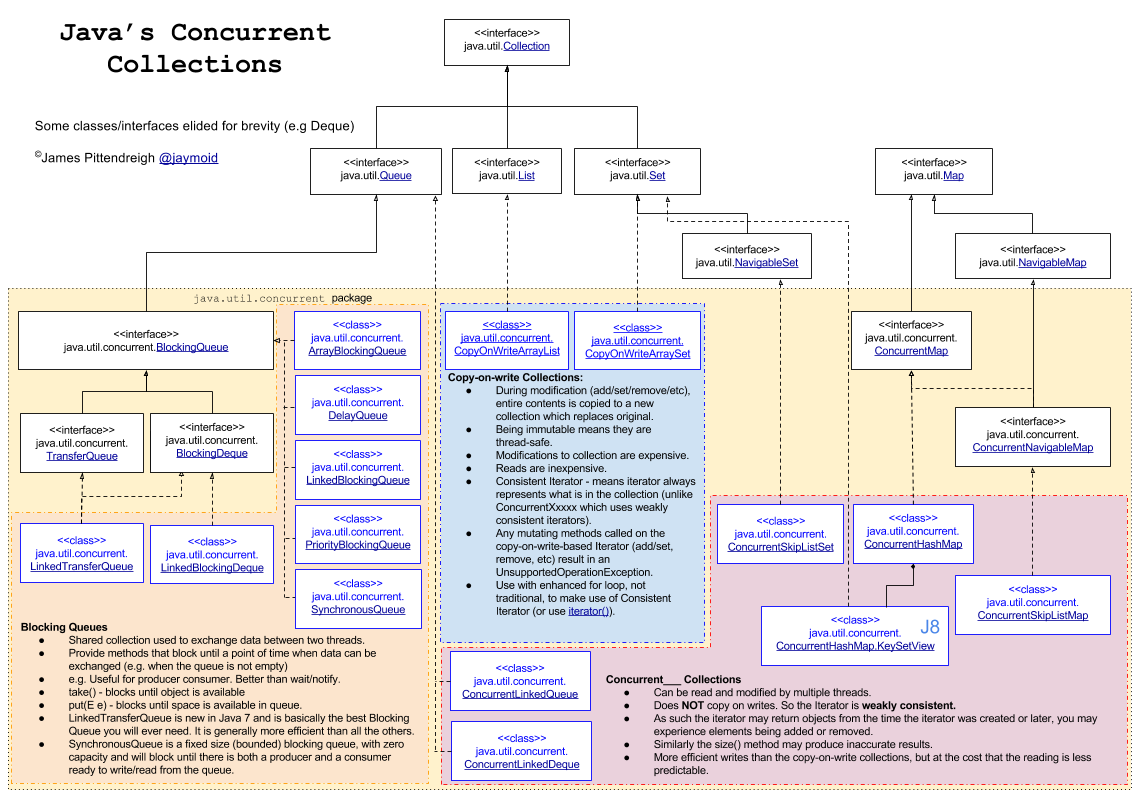
All of these collections help avoid Memory Consistency Errors by defining a happens-before relationship between an operation that adds an object to the collection with subsequent operations that access or remove that object
Synchronized Collections
These classes synchronize every public method, and hence slow
getter + setter
Vector
HashTable
Collections.synchronizedXXX()
Performs locking for all operations including both reads and writes
Still you must iterate in synchronized block to avoid unexpected results??
Existing compound operations are made atomic like:
remove or replace a key-value pair only if the key is present
add a key-value pair only if the key is absent
Implementation:
ConcurrentHashMap — analog of HashMap
ConcurrentSkipListMap — analog of TreeMap
ConcurrentHashMap
Reads do not entail locking, multiple threads can read without any issue
Writes perform locking at segment/bucket level (Java 8 might have bucket level, not confirmed)
Neither null key nor null value allowed
Iterator never throws ConcurrentModificationException
Compared to Collections.synchronizedMap(), ConcurrentHashMap has:
better concurrency
fine grained locking
Never throw ConcurrentModificationException, while synchronizedMap may throw
// Throws exception:// - new HashMap<>()// - Collections.synchronizedMap(new HashMap<>())// Do not throw exception:// - new ConcurrentHashMap()Map<String, Integer> hashMap = new HashMap<>();hashMap.put("a", 1);hashMap.put("b", 2);for (Map.Entry<String, Integer> entry : hashMap.entrySet()) { System.out.println(entry.getKey() + ": " + entry.getValue()); hashMap.put("c", 3); // throws ConcurrentModificationException}
Copy On Write Collections
Read:
No locks involved while reading
Iterator is Fail-safe
When read is invoked the iterator returned is an immutablesnapshot of the original array
The iterator cannot do write operations like: add(), set(), remove()
Write:
Uses ReentrantLock internally and allows only one thread to write
Create a new array and modifies it by performing write operation
Update the reference to the new array and release the lock
Use case:
It solves the issue when traversal and modification is happening concurrently which can throw ConcurrentModificationException
In general single Random read and modification concurrently is not that problematic but traversal is problematic
Traversal does not involve locks and hence faster
Good for systems with heavy traversal operations without worrying about concurrent modifications and writes are infrequent
Example includes many Event-Notification systems
Delivering a notification requires iterating the list of registered listeners and calling each one of them
In most cases registering/unregistering is far less common than receiving event notification
Compared to ArrayList
More memory needed
Slow on writes
Follows eventual consistency and delay between writes and visibility
Implementation:
CopyOnWriteArrayList
CopyOnWriteArraySet
Iterator
Fail-fast
Collections maintain an internal counter called modCount
Each time an item is added or removed from the Collection, counter gets incremented.
On each next() call, the current value of modCount gets compared with the initial value. If there’s a mismatch, it throws ConcurrentModificationException which aborts the entire operation
Remark: In Single Thread ConcurrentModificationException happen if the objects are removed from collection directly rather than through iterator
Remark: If during iteration over a Collection, an item is removed using Iterator‘s remove() method, that’s entirely safe and doesn’t throw an exception