SQL
Types of database languages
Data Definition Language (DDL)
CREATE, ALTER, DROP, TRUNCATE, RENAME, etc.- All these commands are used for updating the data that’s why they are known as Data Definition Language.
Data Manipulation Language (DML)
SELECT, UPDATE, INSERT, DELETE, etc.- These commands are used for the manipulation of already updated data that’s why they are the part of Data Manipulation Language.
DATA Control Language (DCL)
GRANT and REVOKE.- These commands are used for giving and removing the user access on the database. So, they are the part of Data Control Language.
Transaction Control Language (TCL)
COMMIT, ROLLBACK, and SAVEPOINT.- These are the commands used for managing transactions in the database. TCL is used for managing the changes made by DML.
SQL constraints
NOT NULL - Restricts NULL value from being inserted into a column.CHECK - Verifies that all values in a field satisfy a condition.DEFAULT - Automatically assigns a default value if no value has been specified for the field.UNIQUE - Ensures unique values to be inserted into the field.INDEX - Indexes a field providing faster retrieval of records.PRIMARY KEY - Uniquely identifies each record in a table.FOREIGN KEY - Ensures referential integrity for a record in another table.
JOIN
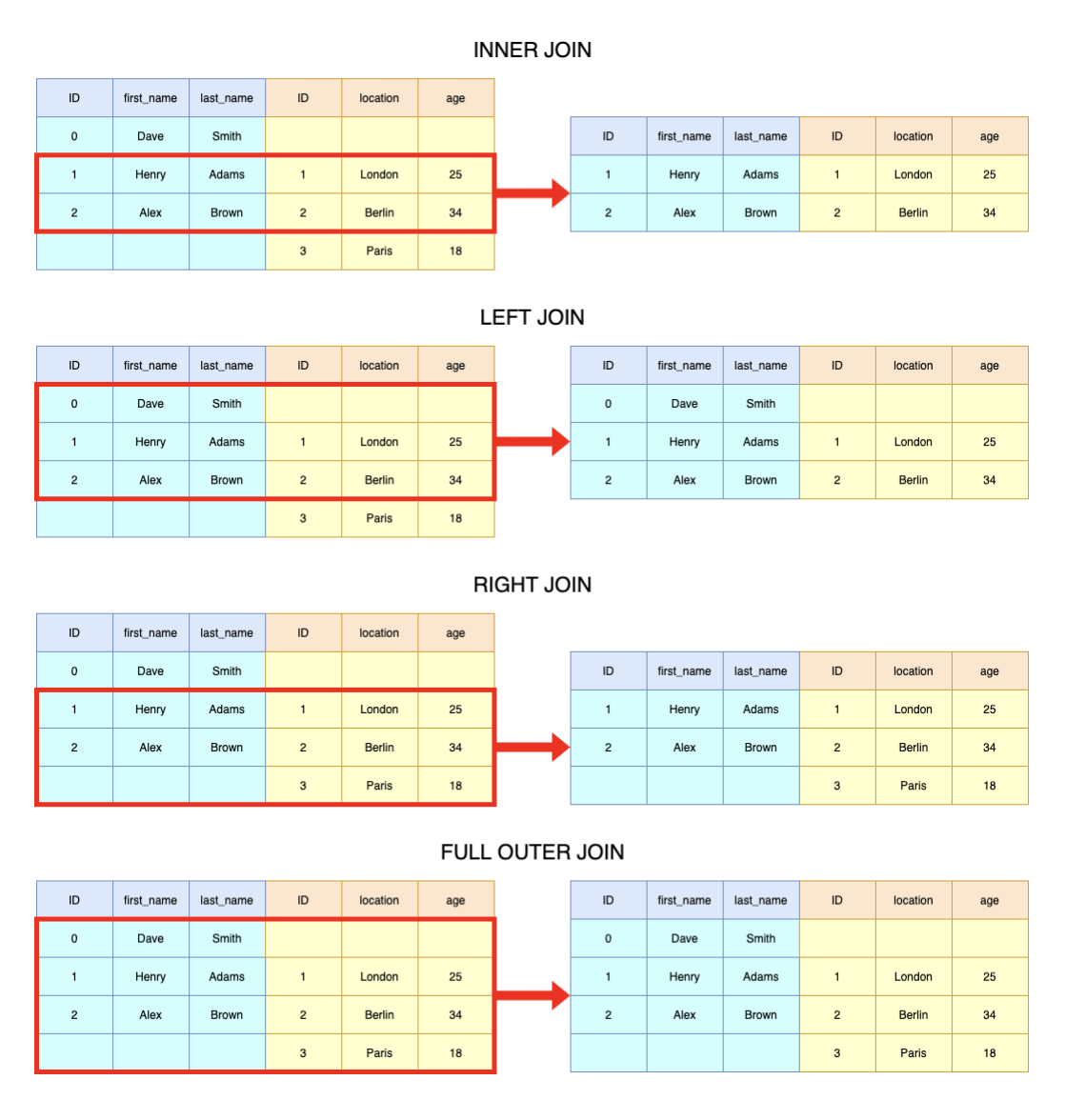
- The SQL Join clause is used to combine records (rows) from two or more tables in a SQL database based on a related column between the two.
(INNER) JOIN: A intersect BLEFT (OUTER) JOIN: A + (A intersect B)RIGHT (OUTER) JOIN: B + (A intersect B)FULL (OUTER) JOIN: A + B + (A intersect B)
WHERE
Group By
- We think
groupby as three steps (Hadley Wickham of Rstats fame):
- The
split step involves breaking up and grouping a DataFrame depending on the value of the specified key.
- The
apply step involves computing some function, usually an aggregate, transformation, or filtering, within the individual groups.
- The
combine step merges the results of these operations into an output array
flowchart TD
A["split <br> (create different groups)"]
B["apply <br> (aggregate/transform/ <br> filtering on each group)"]
C[combine]
A --> B --> C
Having
SQL execution order
DELETE vs TRUNCATE vs DROP
DELETE: has WHERE clause, deletes rows of the table
TRUNCATE: doesn’t have WHERE clause and deletes contents of table
DROP: deletes the table
Joins vs where
3 items under this folder.