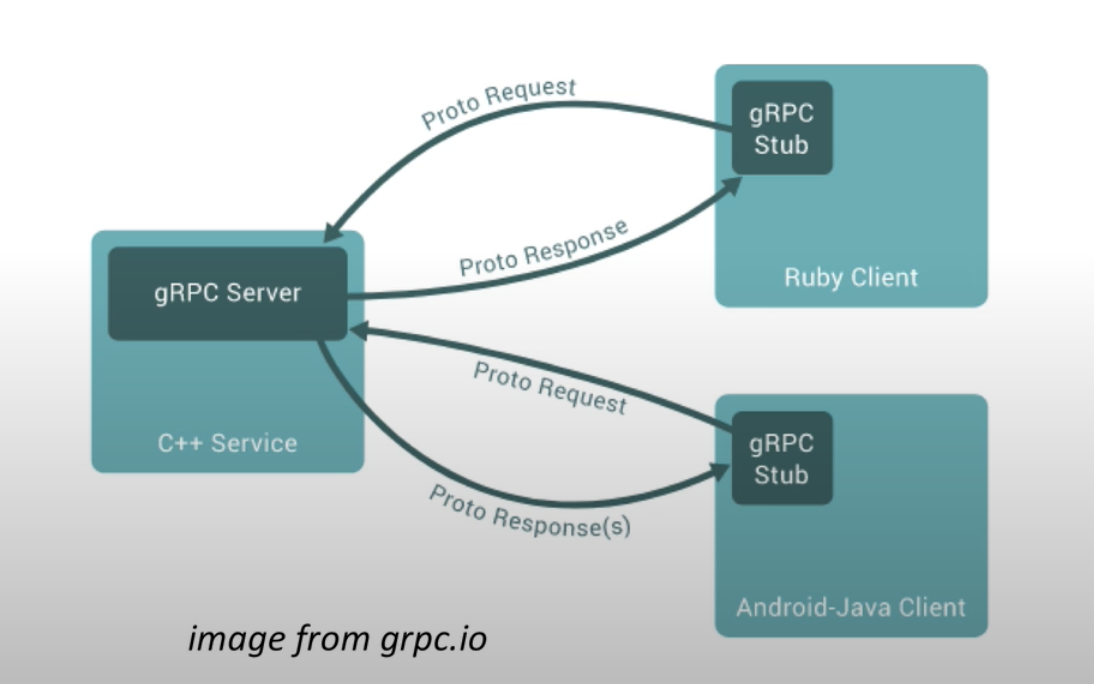
free and open source framework developed by Google
it is part of CNCF (Cloud Native Computation Foundation) - like Docker and Kubernetes
It allows you to define REQUEST and RESPONSE for RPC (Remote Procedure Calls) and handles all the rest for you.
gRPC = HTTP/2 + Protobuf
pros:
Modern, fast and efficient
Built on HTTP/2
low latency, supports streaming, language independent
easy to plug in authentication, load balancing, logging and monitoring
RPC (Remote Procedure Call)
RPC feels like calling a function on the server code from a client code
gRPC is popular implementation of RPC
Advantage of RPC is that you don’t need to write communication logic again and again, it hides the complexity of API call
failures
retries
communication protocol
compression
streaming
In RPC world we need to generatestubs for each language
Stubs:
serialize/deserialize
convert methods/request types/response types to be used by RPC system
Stub Interface Definition Language is used to define the types in multiple languages. In gRPC we write .proto files for this
How to get started
You need to define the messages and services using Protocol Buffers
The rest of gRPC code is generated for you and you’ll have to provide implementation for it.
One .proto file works for over 12 programming languages (server and client) and allows you to use a framework that scales to millions of RPC per second.
Methods
gRPC supports four types of methods for client server interaction:
Unary - The traditional request-response communication
Client streaming - The client sends a series of messages to the server and the server returns a response after processing them.
Server streaming - The client needs to make a single request for the server to return a response with a stream of messages.
Bidirectional streaming - The client and server can communicate with each other asynchronously over a persistent session.
Calling
Define URL:
example: grpc.postman-echo.com
Define Method:
example: HelloService/SayHello
Each method is one of the types mentioned above
Define Message:
Message can be any format including json
It is converted into Protobuf format before sending/receiving
For example in the case of client streaming method, You can stream multiple messages and end the stream and then send
gRPC Flow
Permify
Permissions
Roles = Collection of Permissions
We need to store permissions and roles in some database/service
View Role
cart_view
product_view
API Call to Server (What Server does)
Receive request
Identify request token
using identity of the token, we send request to permify with permissions
permify authenticates the token
permify checks if the identity of the token has the permissions
permify returns response
Tasks
How to call permify via typescript client
How to configure grpc and ports in local and cloud
How proto files are setup, local setup grpc server + client
How to run permify project locally
How to run via make command
Latency calculate: local vs cloud
How to setup cache
How to do multi-instance (distributed instance)
Extended:
How to use WebSocket
What happens in metadata of gRPC
does grpc use https internally? is grpc a new protocol