Tenant
- Any customer that you sign up to use your SaaS environment is one of the tenants of your system.
- The sum total of all the customers using your SaaS environment are the tenants.
- Each tenant pays for access to the SaaS application by paying a subscription fee.
- Tenants are distinct from users.
- Multiple users from a single organization, company, or group form a single tenant.
- ref: https://learn.microsoft.com/en-us/azure/architecture/guide/multitenant/overview
Considerations
- What exactly is tenant for you? A customer, user or a group of user (like team)
- For example, a music streaming service might support both individual users and families.
- What commercial pricing models will your solution offer, and how will your pricing models affect your multitenancy requirements?
- Do any of your tenants have unusual or special requirements?
- For example, biggest customer need higher performance/stronger guarantees than others
Multi-tenant models
- Have an identity service which then can be used in requests to identify you
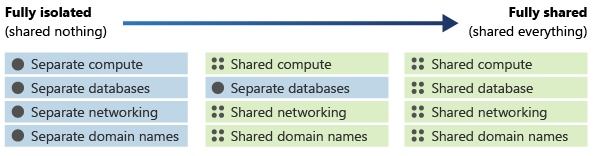
- For each customer, we can have:
- separate services or single service?
- separate databases or single database with
tenantIdas filter?
- Implications:
- Security: Be careful not to access data from one tenant when you return response to another
- Cost: Shared is more cost effective
- Performance: Shared is less performant
- Reliability: Shared can cause single point of failure for all tenants
What is Azure elastic pool? https://learn.microsoft.com/en-us/azure/azure-sql/database/elastic-pool-overview?view=azuresql