Microservices Design Pattern
- Azure Cloud: https://learn.microsoft.com/en-us/azure/architecture/patterns/
- Azure Microservices Design Patterns: https://learn.microsoft.com/en-us/azure/architecture/microservices/design/patterns
- https://microservices.io/patterns/index.html
- spring cloud helps in implementing them?
- SAGA (V. imp.)
- Decomposition
- Strangler
- CQRS
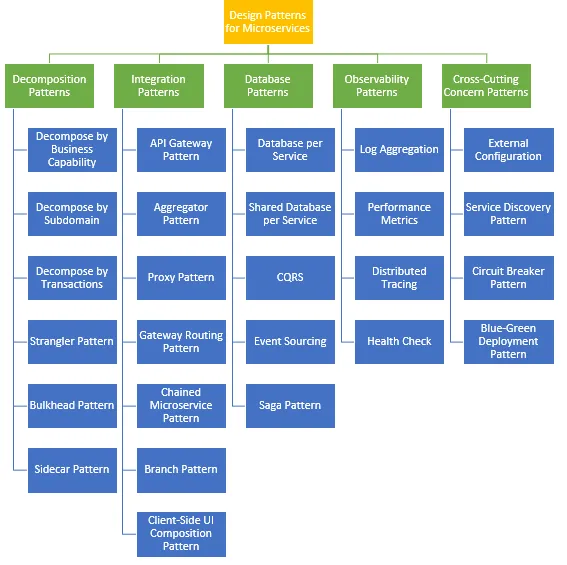
Common Patterns
- Decomposition
- Domain-based microservices
- Business process-based microservices
- Atomic Tx-based microservices
- Strangler
- Sidecar
- Database
- Database per service
- Shared Database per service
- Data
- CQRS
- Saga
- Event Sourcing
- Integration
- API Gateway pattern
- BFF pattern
- Cross Cutting Concerns
- External Configuration
- Discovery:
- Service Registry
- API Gateway
- Client Side Discovery
- Server Side Discovery
- Circuit Breaker pattern
- Observability
-
Logs
-
Metrics
-
Distributed Tracing
-
Health Check
-
API Gateway Pattern
- Provides a centralized entry point for managing interactions between clients and application services.
- Stores API contract and version control
- It performs following:
- Gateway Routing:
- Acts as a reverse proxy
- Routes client requests to appropriate services
- Gateway Aggregation:
- Aggregate multiple client requests into a single request.
- Gateway Offloading: provide cross-cutting functionality
- SSL termination
- Mutual TLS
- Authentication
- IP allowlist or blocklist
- Client rate limiting (throttling)
- Logging and monitoring
- Response caching
- Web application firewall
- GZIP compression
- Servicing static content
- Gateway Routing:
- https://learn.microsoft.com/en-us/azure/architecture/microservices/design/gateway
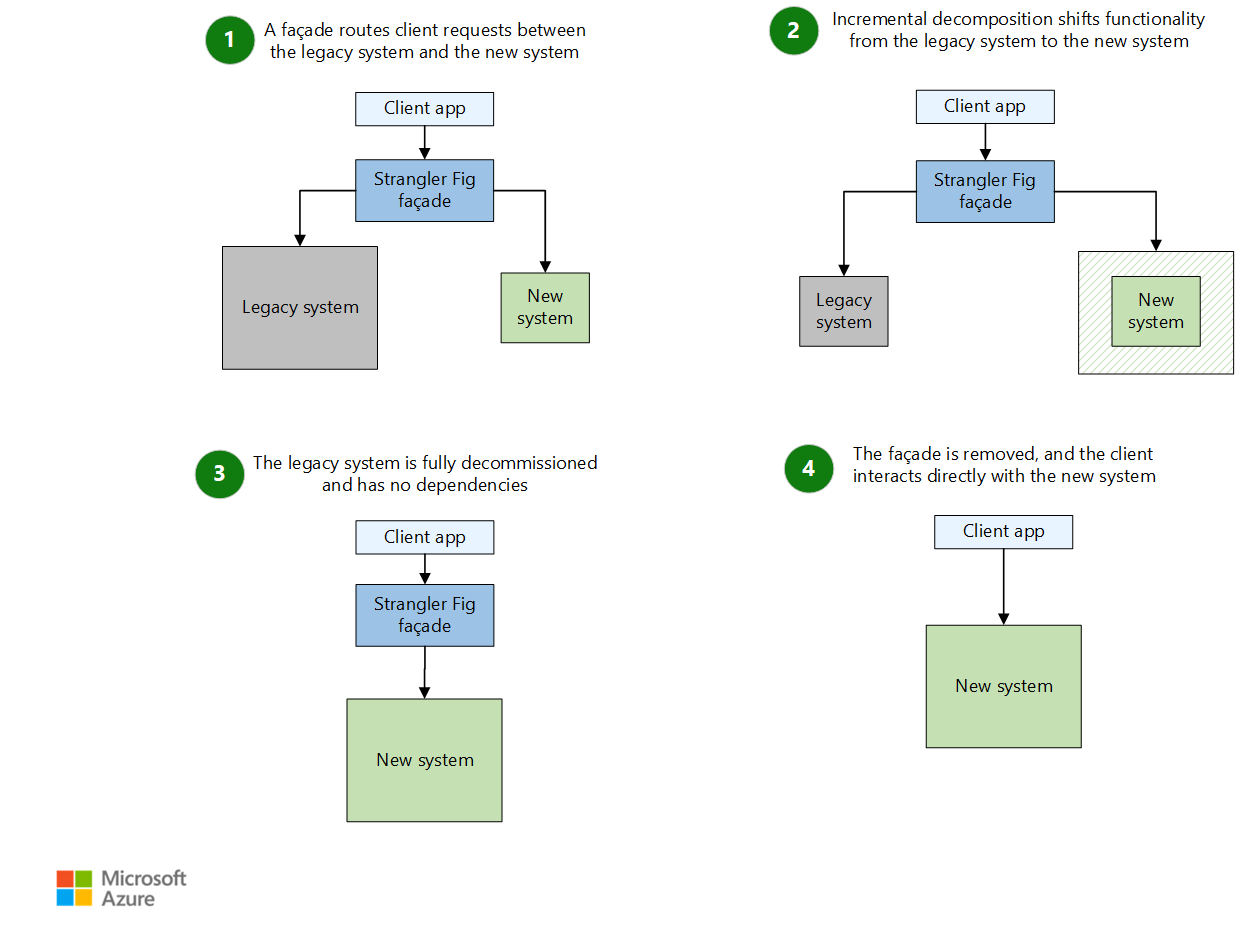
Strangler Pattern
- aka Strangler Fig
- Because Strangler Fig Tree grows on host tree often resulting in host’s death
- Incrementally migrate a legacy system by gradually replacing specific pieces of functionality with new applications and services.
- Initially you can pass 10% load of web requests to the microservices and 90% on legacy monolithic service
- If failure happens we can make microservice load to 0%
- If success we can incrementally increase load towards 100% and finally decommission the legacy monolithic service
- Uses
- migrate legacy system by breaking down monoliths
- https://learn.microsoft.com/en-us/azure/architecture/patterns/strangler-fig
- https://java-design-patterns.com/patterns/strangler/
Database management in microservice
- Database management in microservice
- each service has its own DB
- all service has shared DB
- shared DB disadvantages:
- scaling with demand of each microservice is not good since shared need to be scaled even though only one microservice has high demand
- same table might be used by different microservices, hence modification can cause issues
- shared DB advantages:
- JOINs are easily handled
- transactions are easily handled (ACID)
- assume I need to insert into 10 tables, then I can perform transaction easily and in case of failure can rollback
- DBs per service
- SAGA pattern helps perform transactions (ACID)
- CQRS pattern helps distributed DBs perform JOINs
Sidecar Pattern
- aka Sidekick pattern
- Resembles a sidecar attached to a motorcycle.
- Deploy components of an application into a separate process or container to provide isolation and encapsulation.
- Provides supporting features for the parent application
- Shares the same lifecycle as the parent application (creation, deletion)
- Examples
- Infrastructure API
- Infrastructure team creates a service alongside each application which performs logging, environment data, configuration store, discovery, health checks, and watchdog services
- the sidecar also monitors parent application’s host environment and process and logs the information to a centralized service
- Deploy Ambassador as sidecar
- Deploy Nginx reverse proxy as sidecar
- Infrastructure API
- https://learn.microsoft.com/en-us/azure/architecture/patterns/sidecar
Ambassador Pattern
- Create helper services that send network requests on behalf of a consumer service or application
- Often used with legacy applications or applications that you cannot modify
- This helps to extend their networking capabilities for example adding circuit breaker to a legacy application
- https://learn.microsoft.com/en-us/azure/architecture/patterns/ambassador
Anti-corruption Layer Pattern
- Implement a façade or adapter layer between different subsystems that don’t share the same semantics
- first described in Domain-Driven Design by Eric Evans
- Uses
- A migration is planned to happen over multiple stages, but integration between new and legacy systems needs to be maintained.
- Two or more subsystems have different semantics, but still need to communicate.
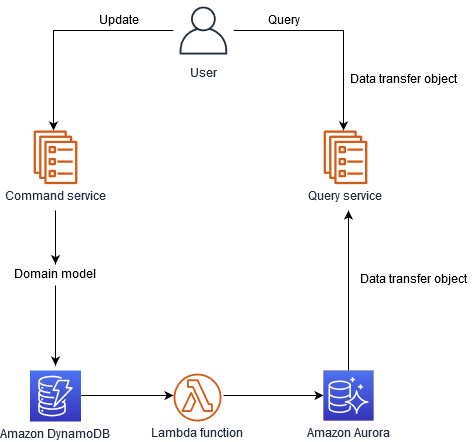
CQRS
- Command Query Responsibility Segregation
- Segregates read and write operations for a data store into separate data models
- Improves performance and scalability
- Commands represent write operations
- should represent a business task
- process commands in Async by placing them into Queue
- Queries represent read operations
- we can have materialized views to improve query performance
- Benefits:
- enables the read models and write models to scale independently.
- read and write schemas can be optimized separately
- simpler queries
- Disadvantages:
- Eventual Consistency
- Increased complexity
- Example: ??
- https://learn.microsoft.com/en-us/azure/architecture/patterns/cqrs
- https://docs.aws.amazon.com/prescriptive-guidance/latest/modernization-data-persistence/cqrs-pattern.html
Event Sourcing
- https://learn.microsoft.com/en-us/azure/architecture/patterns/event-sourcing
- Instead of storing just the current state of the data in a relational database, store the full series of actions taken on an object in an append-only store.
- Command Handlers
- Calls the event store to get the historical events for the entity
- Events are played back in the object to materialize the current state of the entity
- The business logic is run and events are raised
- It is relatively expensive to read and replay events
- applications typically implement materialized views
- Often combined with CQRS Pattern
- Advantages
- Events are immutable and can be stored using an append-only operation
- Can help prevent concurrent updates from causing conflicts because it avoids the requirement to directly update objects in the data store
- Provides an audit trail to monitor actions taken on entity
- Disadvantages
- It is complex to implement and should be avoided
- Eventual Consistency
- Current state of an entity can be determined only by replaying all of the events
- Consumers must be idempotent to avoid re-applying same update
-
Examples
Bulkhead Pattern
- aka cell-based architecture
- Named after the sectioned partitions (bulkheads) of a ship’s hull
- If the hull of a ship is compromised, only the damaged section fills with water, which prevents the ship from sinking
- Application design that is tolerant of failure
- Elements of an application are isolated into pools so that if one fails, the others will continue to function
- Partition service instances into different groups, based on consumer load and availability
- Consider deploying them into separate VMs, containers, or processes.
- asynchronous messages can be isolated through different sets of queues
- Each queue can have a dedicated set of instances
Messaging Bridge Pattern
- Integrate disparate systems that are built on top of different messaging infrastructures
- old system with old message queue ⇐-⇒ message bridge ⇐⇒ new msg queue ⇐→ new system
Blue-Green Deployment
- Two identical environments, referred to as “blue” and “green,” are set up.
- One environment (blue) is running the current application version and one environment (green) is running the new application version.
- Once green environment is tested, the live traffic is directed to it, and the blue environment is used to deploy a new application version during next deployment cycle.
- Reduces the risk associated with deploying new versions of an application